At the Edge of Extinction
$1000
Print on Canvas
Picture Dimension 19 ¾” x 27 ¼ ”
Picture with frame Dimension 24″ x 36″
Mixed Media – Hand-drawn images are converted into digital art.
Limited Edition Certification
(Only 5 exclusive signed copies are available)
Description
Beneath the silt-heavy surface of the northernmost slice of the Gulf of California, the world’s smallest cetacean is fighting a quiet battle against extinction. Measuring just five feet in length, the vaquita (Phocoena sinus) is the most endangered marine mammal known to science. Their entire existence is bound to a fragile, geographically restricted sanctuary of just 1,545 square miles. [1, 2, 3]
This hyper-specific pocket of the ocean is heavily shaped by the Colorado River Delta. Historically, the Colorado River deposited massive amounts of freshwater, nourishing silt, organic sediment, and vital nutrients directly into the Upper Gulf. This constant influx created a highly complex, dynamic estuarine environment that functions as one of the Earth’s most diverse marine habitats—serving as a crucial nursery and feeding ground for an abundance of fish, shrimp, and squid. [1, 2, 3, 4]
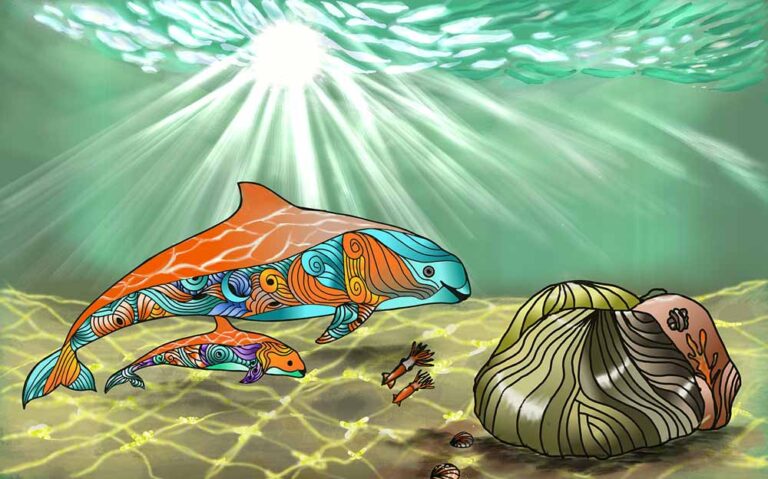
It was within this nutrient-rich, turbid home that a brilliant moment of hope was captured in September 2025. Observers working with Sea Shepherd, Pronatura Noroeste, and the Mexican Navy secured drone footage of a mother vaquita swimming alongside a newborn calf. For a species with fewer than ten individuals left on Earth, this brief glimpse of a tiny calf breaking the water’s surface carries the weight of an entire ecosystem.
The footage highlighted the vaquita’s most striking features: the deep, dark patches around their eyes that resemble eyeliner or delicate tattoos. Yet, the beauty of these creatures stands in stark contrast to the invisible dangers threading through their habitat. For decades, vaquitas have been accidentally caught and killed in gillnets, which hang blindly in the water and trap marine life by their bodies. The primary catalyst for their decline is the illegal fishing of the totoaba (Totoaba macdonaldi), a large, endangered fish whose swim bladders are highly prized and trafficked to East Asian markets. Sound-based monitoring by CIRVA (the International Committee for the Recovery of the Vaquita) tracked a devastating collapse, watching the population plummet from roughly 567 animals in 1997 to fewer than 20 by 2018. Subsequent joint surveys by Sea Shepherd and Mexican scientists estimated a minimum of 10 to 13 survivors in 2023, with the 2024 survey placing the most recent count at a critical 6 to 8 individuals.
This makes the sighting of a new calf profoundly significant. Vaquitas are slow to reproduce; females carry a single baby for a gestation period of 10 to 11 months, giving birth only once every one to two years, and they do not reach breeding maturity until they are between 3 and 6 years old. With so few breeding females left in the wild, every new birth offers a measurable lifeline. There is an incredible resilience hidden within their biology: a landmark 2022 genetic study published in Science discovered that vaquitas do not carry a heavy load of harmful, inherited genetic problems despite their tiny population size. In theory, their gene pool is robust enough that they could fully recover from these perilously low numbers if the threat of illegal gillnets were completely erased. [1, 2]
The artwork “At the Edge of Extinction“ serves as a visual testament to this precise threshold of survival. It contrasts the heartbreaking trajectory of their decline against the undeniable biological resilience of a newborn calf in the historic delta waters. The piece reminds us that the vaquita has not given up on the Upper Gulf of California, and their future relies entirely on our human commitment to clear the nets from their only home on Earth. [1]