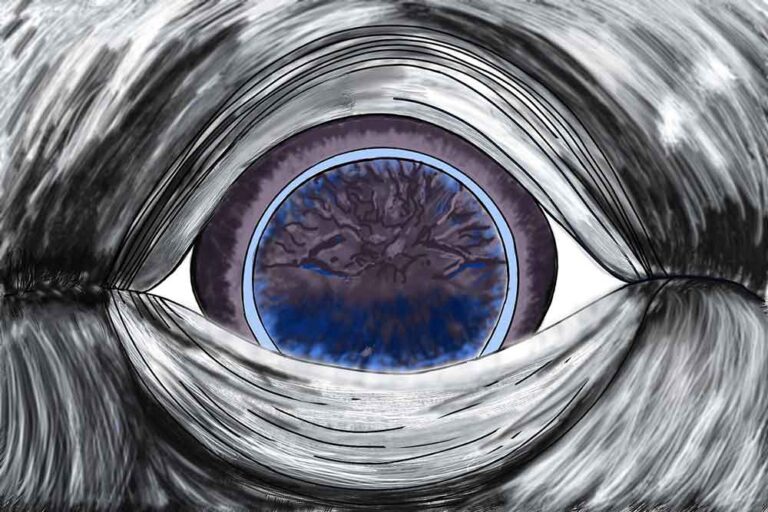
Beneath the Loud Wake, An Eye in the Blind Spot
Picture Dimension 19 ¾” x 27 ¼ ”
Picture with frame Dimension 24″ x 36″
Mixed Media – Hand-drawn images are converted into digital art.
Limited Edition Certification
(Only 5 exclusive signed copies are available)
Description
Gray whales have made the same journey for thousands of years. Every year they travel between the Arctic feeding grounds of the Bering and Chukchi Seas and the warm lagoons of Baja California, where they give birth. At up to 12,000 miles round trip, it is one of the longest migrations of any mammal on Earth.
That journey depends on a single feast. All summer in the Arctic, gray whales roll onto their sides and suck mud from the shallow sea floor, filtering out tiny crustaceans called amphipods. They eat enough in those few months to carry them through the entire migration and the long winter that follows.
But the Arctic is changing. As sea ice melts earlier and forms later, the ice algae that once rained down to the sea floor and fed those amphipods is disappearing. The food the whales have always relied on is thinning out. Many are arriving at the end of summer without the reserves they need.
The result is written on their bodies. Researchers are seeing more thin and emaciated gray whales, with ribs and shoulder blades showing beneath the skin. Fewer calves are being born. Since 2019, gray whales have been dying in unusually high numbers along the Pacific coast, prompting NOAA to declare an Unusual Mortality Event. The population has dropped sharply, from around 27,000 a decade ago to among the lowest counts seen since the 1970s.
Hungry whales go looking for food wherever they can find it. More of them now turn into places they rarely used to linger, like San Francisco Bay. There, they share the water with ferries, cargo ships, and pleasure boats. The bay is loud, crowded, and fast. A whale feeding near the surface or resting in a shipping lane is nearly invisible from a moving vessel. And from the whale’s side, with eyes set far apart on either side of its head, the approaching ship may be just as hard to see. Both are moving through each other’s blind spots.
Vessel strikes have become one of the leading causes of gray whale deaths in the bay.
This eye was looking out from beneath that wake. It belongs to a whale that came a very long way, carrying the weight of a warming Arctic in its body, searching for enough to eat. It is watching a world that has grown too loud and too fast around it.
We can’t refreeze the Arctic overnight. But we can slow down. We can watch the water in places where whales are feeding. We can report sightings, give whales space, and support the people working to understand what is happening to them. We can treat climate change as what it is for these animals: a question of whether they will have enough food to survive.
The gray whale came back once before, after commercial whaling nearly wiped it out. With our help, it can come back again.